StrategyUpdated 21 Jun 20263 min read
What Is Value Betting?
Value betting means backing an outcome whose odds imply a lower probability than its true chance. In plain terms: you bet only when the price is too generous.
That single idea is the entire game — and it's the only approach to betting that makes money over time, because it's the only one based on the price being wrong rather than a feeling about who will win.
See it for yourself#
Drag the two sliders. The grey bar is the chance the price assumes; the coloured bar is your estimate. The moment your estimate climbs above the price, you have value.
Your estimate beats the price by 10.0 points — a value bet worth +25.0% per unit staked.
The one piece of math behind it#
Every price carries an implied probability: implied % = 1 ÷ decimal odds. Compare that to your own estimate. Higher than the price implies? Value. Lower? Walk away.
A +25% edge means that, over many identical bets, each unit returns 25% on average — not because you win every time, but because the price pays more than the risk deserves. (Need to switch between odds formats while you read prices? Use the odds converter.)
Why "winning often" is a trap#
The most common mistake is judging bets by how often they win. You can profit winning 40% of the time and go broke winning 70% — it depends entirely on the prices you took.
| Approach | Strike rate | Avg odds | Long run |
|---|---|---|---|
| Chasing favourites | 70% | 1.30 | Loses money |
| Value betting | 40% | 3.00 | Makes money |
The number that matters is never how often you win — it's whether the price was bigger than the probability justified.
Where the edge actually comes from#
Value only exists if your probability estimate is genuinely better than the bookmaker's. Bookmakers price big, heavily-watched matches very well, so edges hide in the games the market models less carefully: lower divisions, smaller leagues, and markets like totals and handicaps where the crowd's attention is thin.
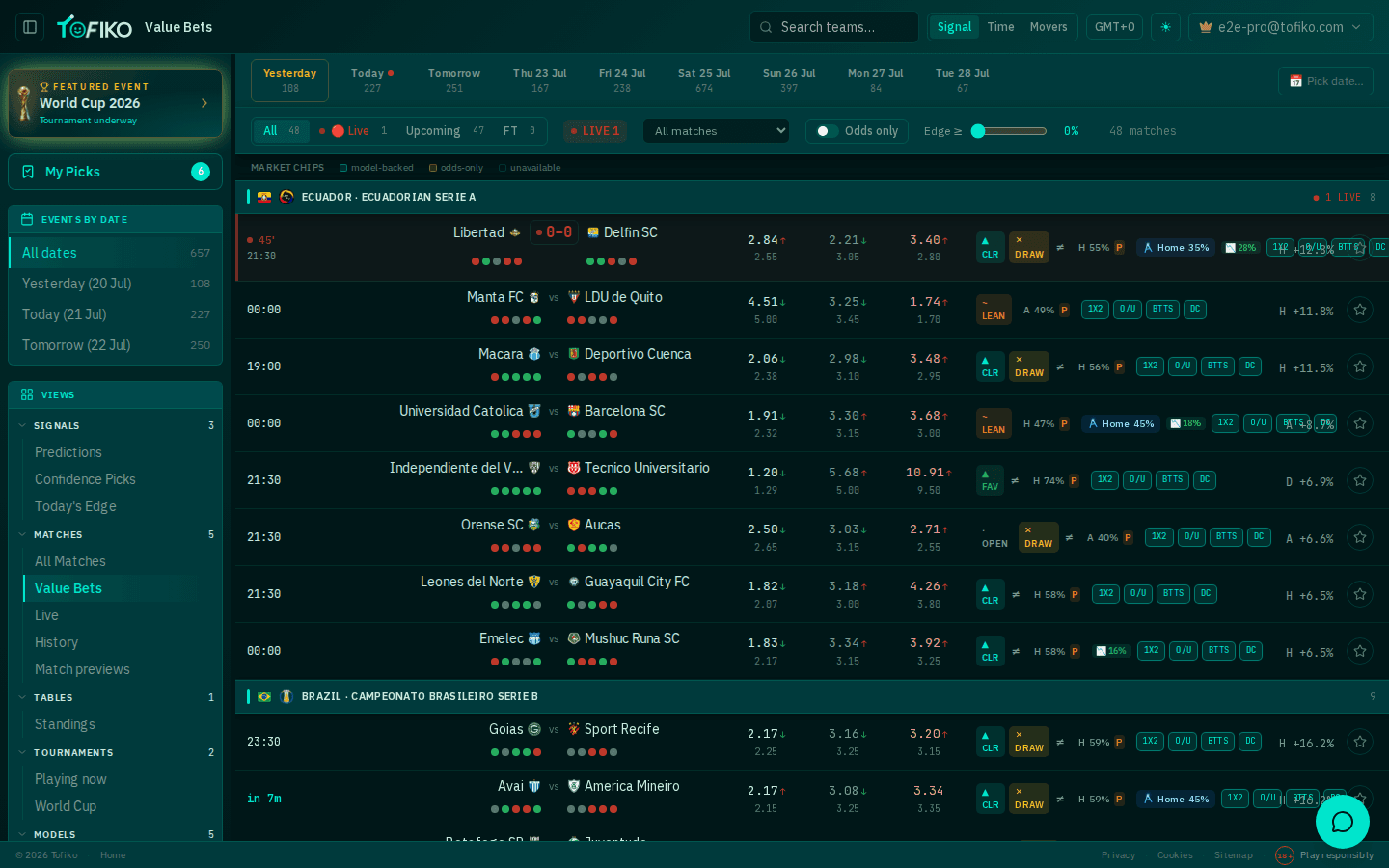
Finding value there needs a way to estimate true probabilities that doesn't rely on gut feeling — which is exactly what statistical models do. Tofiko's Poisson, Dixon-Coles, and Elo models turn historical data into probabilities across hundreds of leagues and publish them next to live prices on the predictions pages.
Value betting only works if your numbers genuinely beat the bookmaker's. If your estimates are worse — as most gut estimates are — what feels like value is just you being wrong more confidently. A method you can't verify is a story, not an edge — which is why closing line value, not profit, is the measure worth watching. That's why Tofiko publishes its model accuracy openly, losing streaks included.
The method, start to finish#
- Estimate the true probability honestly — ideally with a model, not a feeling.
- Read the price's implied probability (1 ÷ decimal odds).
- Bet only when yours is clearly higher — the gap is your edge.
- Stake to survive variance with sound bankroll management.
- Track everything, losing runs included, so you can tell a real edge from a lucky streak — and know how many bets that actually takes.
Related
- Expected Value in Betting: The Number That Decides Everything
- Bankroll Management: Why Staking Beats Picking
- The Kelly Criterion: Sizing Bets to Your Edge
- Closing Line Value: The Only Scoreboard That Answers in a Season
- 1X2 Explained: Football's Default Market, and the One Bookmakers Price Best
- Odds Converter — Decimal, Fractional, American & Implied Probability
- Kelly Criterion Calculator — Optimal Bet Size From Your Edge
- Break-Even Calculator — The Strike Rate Every Price Demands
Frequently asked questions
Is value betting legal?
Yes. You're identifying outcomes the bookmaker has mispriced, not breaking any rule. Some bookmakers limit accounts that consistently beat their lines, but the activity itself is legal.
Do I need to win most of my bets to make value betting work?
No. Value betting can be profitable with a strike rate well below 50%, as long as the odds you take are higher than the true probability justifies. It's about price versus probability, not how often you win.
How is value betting different from following tipsters?
A tipster sells you picks. Value betting is a method: you compare a price to a probability and bet only when the price is too generous. You can apply it yourself, and you can check whether it's actually working.
Can I value bet without building my own model?
You need a probability estimate that's better than the bookmaker's on the games you bet. Tofiko's models produce those estimates for hundreds of leagues, which is what its Find Value view surfaces.