Math & ModelsUpdated 21 Jul 20263 min read
How Our Models Work: Poisson, Dixon-Coles and Elo
Two independent ways of looking at a football match — how many goals each side should score (Poisson, Dixon-Coles) and how strong each side has proven to be (Elo) — blended into one ensemble probability.
Every probability on Tofiko starts life in one of three models. They are deliberately simple, published methods — no black boxes — and understanding them takes about three minutes.
The goals family#
Poisson#
Football scoring is rare and bursty, which happens to be exactly what the Poisson distribution describes. The model estimates each team's goal expectancy for the fixture — say 1.8 for the home side, 1.1 for the away side — from their attacking and defensive records (expected goals among them), adjusted for home advantage and opposition quality.
Given those two numbers — try your own in the Poisson calculator — Poisson prices every possible scoreline: the chance of 2-1, of 0-0, of 4-2. Sum the scorelines where the home side wins and you have P(home win); likewise for the draw and the away win. The same machinery prices Over/Under 2.5 and Both Teams To Score — that's why those markets come from this family.
Dixon-Coles#
Plain Poisson has one known blind spot: it treats the two teams' goal counts as independent, which slightly underprices 0-0 and 1-1. Real football produces more tight, low-scoring stalemates than independence allows. The Dixon-Coles correction — from the 1997 paper that founded modern football modelling — adjusts precisely those scorelines.
The consequence: Dixon-Coles and Poisson agree almost everywhere else. On our data they pick the same 1X2 outcome in ~98% of matches. That is why we present them as one family with one vote — calling them two independent opinions would be counting the same evidence twice.
The ratings model: Elo#
Elo ignores goals entirely. Every team carries a strength rating that rises when it beats expectations and falls when it disappoints — the same system chess uses. A win over a strong side moves your rating more than a win over a weak one; ratings carry across seasons and adjust for home advantage.
For a fixture, the rating gap converts into win/draw/loss probabilities. Elo knows nothing about scorelines — but it has a long memory of who actually keeps winning, which the goals family can miss when a team's underlying numbers and results diverge.
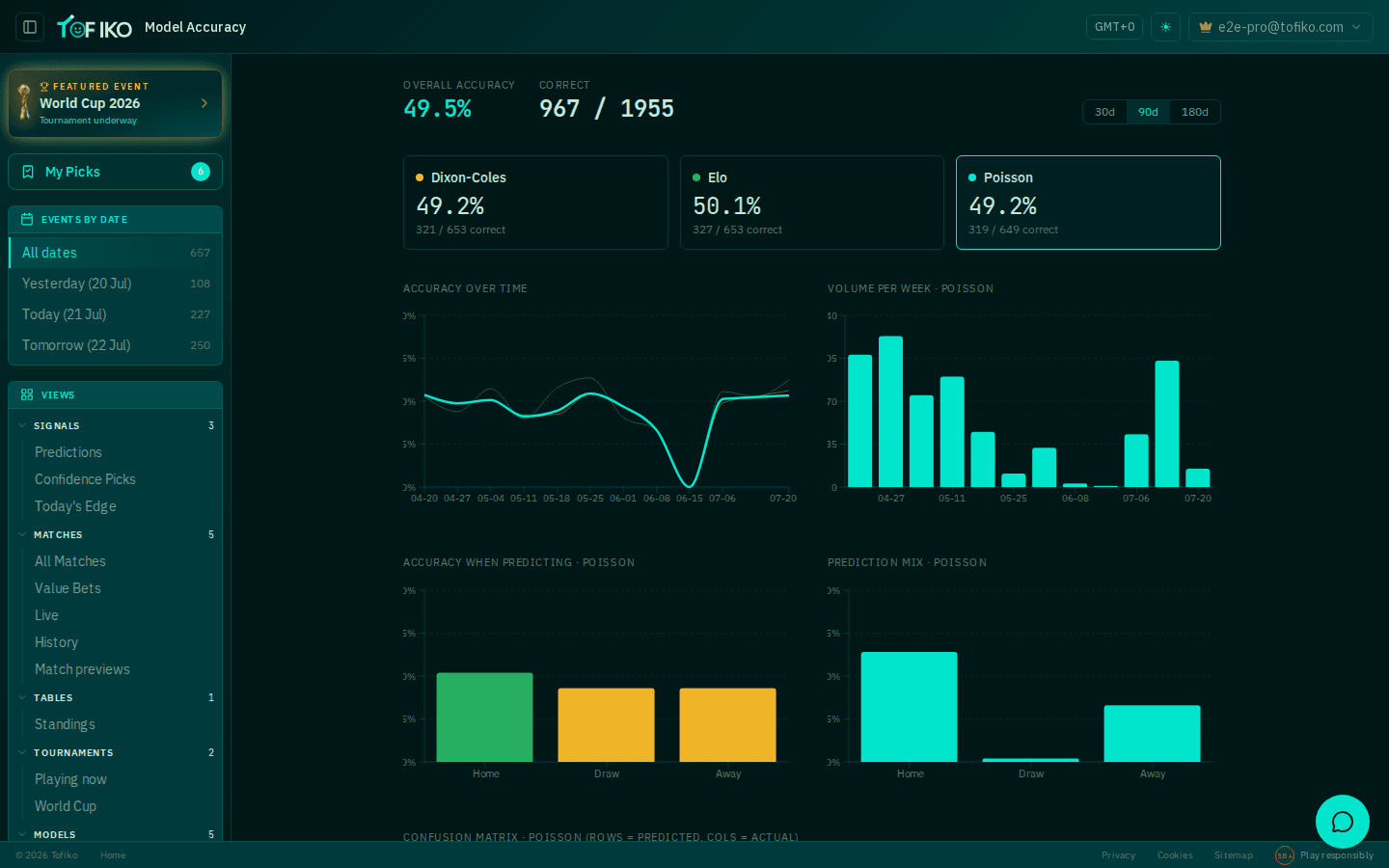
The ensemble — and the family split#
The probabilities you see are the average of the available models. Where you used to see "3/3 models agree" we now show the honest version:
- Model families agree — the goals family and Elo point at the same outcome. Two genuinely different methods reaching one conclusion.
- Model families split — they disagree. Not a malfunction: it usually marks matches where recent results and underlying performance tell different stories. Treat the forecast more loosely.
They are probability engines: they beat naive baselines decisively, and their confidence bands are calibrated (a "strong favourite ≥65%" really has won ~3 of 4 — see the live check on our Performance page). They are not a money machine: benchmarked weekly against the market's closing odds, the market still prices football slightly better. We publish that comparison either way — see the Brier score guide for how the grading works.
Related
- The Brier Score: How We Grade Our Own Predictions
- Fair Odds: What the Bookmaker's Margin Hides
- Calibration: The Only Promise a Prediction Can Keep
- Expected Value in Betting: The Number That Decides Everything
- The Poisson Distribution: Turning Expected Goals Into Scorelines
- Expected Goals (xG), Explained Without the Hype
- Poisson Calculator — Scoreline, 1X2, Over/Under & BTTS Probabilities
Frequently asked questions
What is a Poisson model in football?
A model that estimates how many goals each team should score (its 'expected goals rate'), then uses the Poisson distribution to turn those rates into probabilities for every scoreline — and from there into win/draw/loss chances.
What does the Dixon-Coles correction do?
Plain Poisson slightly misprices low-scoring games — 0-0 and 1-1 happen more often than independent goal counts suggest. Dixon-Coles adjusts exactly those scorelines, which matters because draws live there.
Why does Tofiko say 'two model families' instead of 'three models'?
Because Poisson and Dixon-Coles share the same goal-based view of football and agree on the pick in about 98% of matches. Counting them as two independent opinions would overstate the evidence. The honest count is two voices: the goals family and Elo.
Which model is best?
None dominates. The goals family knows about scorelines and totals; Elo tracks long-run team strength. The ensemble average is more stable than any single member — and when the two families disagree, that itself is information: the match is harder than it looks.